

Latest CIMA F3 Practice Test Questions, F3 Financial Strategy Exam Dumps
May-2026 Pass CIMA F3 Exam in First Attempt Easily
NEW QUESTION # 130
A private company manufactures goods for export, the goods are priced in foreign currency B$.
The company is partly owned by members of the founding family and partly by a venture capitalist who is helping to grow the business rapidly in preparation for a planned listing in three years' time.
The company therefore has significant long term exposure to the B$.
This exposure is hedged up to 24 months into the future based on highly probable forecast future revenue streams.
The company does not apply hedge accounting and this has led to high volatility in reported earnings.
Which of the following best explains why external consultants have recently advised the company to apply hedge accounting?
- A. To provide a more appropriate earnings figure for use in calculating the annual dividend.
- B. To fully adopt IFRS in preparation for listing the company.
- C. To ensure that the venture capitalist receives regular annual returns on its investment.
- D. To make it easier for the market to value the business when it is listed on the Stock Exchange.
Answer: D
NEW QUESTION # 131
Delta and Kappa both wish to borrow $50m.
Delta can borrow at a fixed rate of 12% or at a floating rate of the risk-free rate +3% Kappa can borrow at 15% fixed or the risk-free rate +4%.
Delta wishes a variable rate loan and Kappa a fixed rate loan The bank for the two companies suggests a swap arrangement The two companies agree to a swap arrangement, sharing savings equally What is the effective swap rate for each company?
- A. Delta pays the risk-free rate +2%, Kappa pays 14%
- B. Delta pays 12%, Kappa pays the risk-free rate +4%
- C. Delta pays the risk-free rate +3%, Kappa pays 15%
- D. Delta pays 11%, Kappa pays the risk-free rate +3%
Answer: A
Explanation:
Delta: 12% fixed or rf + 3% floating
Kappa: 15% fixed or rf + 4% floating
Delta's advantage:
Fixed: 3% better (15 # 12)
Floating: 1% better (rf+4 # (rf+3))
Comparative advantage is in fixed; total potential gain from a swap = 3% # 1% = 2%, shared equally # 1% saving each.
So:
Delta (wants floating): (rf + 3%) # 1% = rf + 2%
Kappa (wants fixed): 15% # 1% = 14%
So D: Delta pays rf + 2%, Kappa pays 14%.
NEW QUESTION # 132
A company currently has a 6.25% fixed rate loan but it wishes to change the interest style of the loan to variable by using an interest rate swap directly with the bank.
The bank has quoted the following swap rate:
* 5.50% - 5.55% in exchange for LIBOR
LIBOR is currently 5%.
If the company enters into the swap and LIBOR remains at 5%, what will the company's interest cost be?
- A. 6.25%
- B. 5.70%
- C. 5.75%
- D. 5.00%
Answer: C
Explanation:
Swap quote: 5.50%-5.55% vs LIBOR.
To turn its 6.25% fixed loan into variable, the company must receive fixed and pay LIBOR, so it deals at the bank's bid rate of 5.50%.
Net cost = pay 6.25% (loan) # receive 5.50% (swap) + pay LIBOR
= 0.75% + LIBOR = 0.75% + 5.00% = 5.75%
NEW QUESTION # 133
Two unlisted companies TTT and YYY are being valued. The companies have similar capital structures and risk profiles and operate in the same industry sector It is easier to value TTT than to value YYY because there have recently been several well-publicised private sales of TTT shares.
Relevant company data:
What is the best estimate of YYY's share price?
- A. $1.20
- B. $0.94
- C. $0.68
- D. $0.60
Answer: A
NEW QUESTION # 134
A company is currently all-equity financed.
The directors are planning to raise long term debt to finance a new project.
The debt:equity ratio after the bond issue would be 30:60 based on estimated market values.
According to Modigliani and Miller's Theory of Capital Structure without tax, the company's cost of equity would:
- A. stay the same.
- B. increase.
- C. increase or decrease depending on the bond's coupon rate.
- D. decrease.
Answer: B
NEW QUESTION # 135
The directors of the following four entities have been discussing dividend policy:
Which of these four entities is most likely to have a residual dividend policy?
- A. B
- B. C
- C. A
- D. D
Answer: A
NEW QUESTION # 136
Company A has made an offer to take over all the shares in Company B on the following terms:
* For every 20 shares currently held, Company B's shareholders will receive $100 bond with a coupon rate of 3%
* The bond will be repaid in 10 years' time at its par value of $100.
* The current yield on 10 year bonds of similar risk is 6%.
What is the effective offer price per share being made to Company B's shareholders?
- A. $3.89
- B. $6.43
- C. $6.89
- D. $4.50
Answer: A
NEW QUESTION # 137
A listed company has recently announced a profit warning.
The company's share price fell 20% on the day of the announcement but had been fairly static in the weeks leading up to the announcement.
Which form of efficient market is most likely to be indicated by this share price movement?
- A. Semi-strong form
- B. Weak form
- C. Strong form
- D. Random walk
Answer: A
Explanation:
In semi-strong form market efficiency, share prices reflect all publicly available information, and they react quickly and unbiasedly to new public announcements.
Here, the share price was fairly static before the profit warning, then fell 20% on the day of the announcement. That suggests:
The market did not know this bad news beforehand.
When the profit warning was announced (new public info), the price immediately adjusted.
That is classic semi-strong efficiency behaviour.
Weak form only says prices reflect past price data, not necessarily public news.
Strong form would imply even insider information is already reflected, so you might have seen movement before the announcement.
"Random walk" describes the pattern of price movements, not a level of efficiency in this context.
NEW QUESTION # 138
Company P is a large unlisted food-processing company.
Its current profit before interest and taxation is $4 million, which it expects to be maintainable in the future.
It has a $10 million long-term loan on which it pays interest of 10%.
Corporate tax is paid at the rate of 20%.
The following information on P/E multiples is available: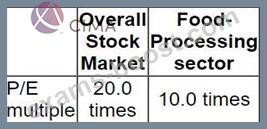
Which of the following is the best indication of the equity value of Company P?
- A. $40 million
- B. $24 million
- C. $48 million
- D. $80 million
Answer: B
NEW QUESTION # 139
At the last financial year end, 31 December 20X1, a company reported:
The corporate income tax rate is 30% and the bank borrowings are subject to an interest cover covenant of 4 times.
The results are presently comfortably within the interest cover covenant as they show interest cover of 8.3 times. The company plans to invest in a new product line which is not expected to affect profit in the first year but will require additional borrowings of $20 million at an annual interest rate of 10%.
What is the likely impact on the existing interest cover covenant?
- A. Interest cover would reduce to 5 times and the covenant would NOT be breached.
- B. Interest cover would reduce to 3 times and the covenant would NOT be breached.
- C. Interest cover would reduce to 5 times and the covenant would be breached.
- D. Interest cover would reduce to 3 times and the covenant would be breached.
Answer: A
NEW QUESTION # 140
A manufacturing company is based in Country L whose currency is the L$.
One of the company's products is exported to Country M, a rapidly growing economy, whose currency is the M$.
In the most recent financial year:
* 100,000 units of the product were sold to customers in country M
* The unit selling price was M$12
The spot rate today is L$1 = M$5
The company has an objective of growth in total sales value in L$ of 10% a year.
If the L$ strengthens by 5% next year against the M$, what volume of sales of this product is needed next year to achieve the objective?
- A. 110,000 units
- B. 104,500 units
- C. 115,500 units
- D. 105,000 units
Answer: C
NEW QUESTION # 141
A private company was formed five years ago and is currently owned and managed by its five founders. The founders, who each own the same number of shares have generally co-operated effectively but there have also been a number of areas where they have disagreed The company has grown significantly over this period by re-investing its earnings into new investments which have produced excellent returns The founders are now considering an Initial Public Offering by listing 70% of the shares on the local stock exchange Which THREE of the following statements about the advantages of a listing are valid?
- A. Provides an exit route for the founders
- B. Increases the profile and reputation of the business.
- C. Reduces agency conflict
- D. Helps access to wider sources of finance.
- E. Increases dividend payouts
Answer: A,B,D
NEW QUESTION # 142
Company A is planning to acquire Company B at a price of $ 65 million by means of a cash bid.
Company A is confident that the merged entity can achieve the same price earnings ratio as that of Company A.
What does Company A expect the value of the merged entity to be post acquisition?
- A. $156.0 million
- B. $207.0 million
- C. $122.5 million
- D. $187.5 million
Answer: C
NEW QUESTION # 143
A company plans to cut its dividend but is concerned that the share price will fall. This demonstrates the_____________
Answer:
Explanation:
effect
Signalling effect (information content of dividends)In CIMA F3, dividend policy is closely linked to information asymmetry between a company's management and its shareholders.
Managers typically have better information about the firm's future prospects than external investors. As a result, investors often interpret changes in dividends as signals about management's expectations of future earnings and cash flows.
The concern that cutting dividends will cause the share price to fall illustrates the signalling effect (also known as dividend signalling theory). According to this theory, a dividend cut is interpreted by the market as a negative signal, suggesting that management expects lower future profits or cash flow difficulties. Investors react by revising their expectations downward, leading to a fall in the share price.CIMA F3 study guidance contrasts this with Modigliani and Miller's dividend irrelevance theory, which assumes perfect markets and no information asymmetry. In reality, markets are imperfect, and dividends convey information. Therefore, companies are often reluctant to reduce dividends even when it may be financially prudent, due to fear of adverse market reactions.This behaviour is also linked to dividend stability, another key concept in F3, where firms prefer stable or gradually increasing dividends to avoid sending negative signals to investors.
NEW QUESTION # 144
Listed Company A has prepared a valuation of an unlisted company. Company B. to achieve vertical integration Company A is intending to acquire a controlling interest in the equity of Company B and therefore wants to value only the equity of Company B.
The assistant accountant of Company A has prepared the following valuation of Company B's equity using the dividend valuation model (DVM):
Where:
* S2 million is Company B's most recent dividend
* 5% is Company B's average dividend growth rate over the last 5 years
* 10% is a cost of equity calculated using the capital asset pricing model (CAPM), based on the industry average beta factor
Which THREE of the following are valid criticisms of the valuation of Company B's equity prepared by the assistant accountant?
- A. The DVM calculation should use Company A's cost of equity rather than Company B's cost of equity
- B. An unlisted company cannot use the capital asset pricing model to calculate its cost of equity
- C. It is better to use the present value of earnings rather than present value of dividends to value a controlling interest
- D. The beta factor used may not reflect Company B's financial risk.
- E. The 5% growth rate may not reflect the future growth of Company B.
Answer: A,D,E
NEW QUESTION # 145
A company has accumulated a significant amount of excess cash which is not required for investment for the foreseeable future.
It is currently on deposit, earning negligible returns.
The Board of Directors is considering returning this excess cash to shareholders using a share repurchase programme.
The majority of shareholders are individuals with small shareholdings.
Which THREE of the following are advantages of the company undertaking a share repurchase programme?
- A. Institutional investors generally prefer a constant predictable income in the form of dividends.
- B. Individual shareholders can realise their investment if they wish.
- C. It reduces the amount of cash for potential future investment opportunities.
- D. The earnings per share should increase for the shareholders who do not sell their shares.
- E. It reduces excess cash which might have been attractive to predators.
Answer: B,D,E
Explanation:
A - Shareholders who want cash can sell into the repurchase.
B - Fewer shares in issue # higher EPS for remaining shareholders.
C - Reduces surplus cash that might attract predators.
NEW QUESTION # 146
A company plans to raise finance for a new project.
It is considering either the issue of a redeemable cumulative preference share or a Eurobond.
Advise the directors which of the following statements would justify the issue of preference shares over a bond?
- A. If profits are poor, dividends do not have to be paid on the preference share - however, interest would need to be paid on the Eurobond.
- B. The issue of the preference share would reduce the company's gearing - however, the Eurobond would increase it.
- C. The company can claim tax relief on the dividend paid on the preference share at a higher rate than the interest paid on the Eurobond.
- D. Preference shares are not secured against the assets of the business - however, the Eurobond would be.
Answer: A
Explanation:
CIMA F3 compares different forms of long-term finance, including preference shares and bonds/Eurobonds, focusing on control, tax treatment, gearing impact, and flexibility.
Statement B captures a key advantage of preference shares from the company's perspective: if profits are poor, preference dividends can be omitted or deferred, especially when they are cumulative. Although unpaid dividends accumulate, non-payment does not normally constitute default in the same way as missing an interest payment on a bond. For a Eurobond, failure to pay interest when due would place the company in default, triggering legal and reputational consequences. This extra flexibility is exactly why preference shares might be favoured over bonds.
Statement A is misleading: Eurobonds are often unsecured, and security (or lack of it) is not a defining difference versus preference shares.
Statement C is incorrect in this context: redeemable cumulative preference shares are typically treated as a financial liability under IFRS (like debt), so they would generally increase gearing, not reduce it.
Statement D is clearly wrong as dividends are not tax-deductible, whereas bond interest normally is.
Therefore, the best justification for issuing preference shares rather than a Eurobond is B.
NEW QUESTION # 147
A venture capitalist has made an equity investment in a private company and is evaluating possible methods by which it can exit the investment over the next 3 years. The private company shareholders comprise the four original founders and the venture capitalist.
Advise the venture capitalist which THREE of the following methods will enable it to exit its equity investment?
- A. Trade sale of shares to an external 3rd party.
- B. The private company undertakes a 1 for 4 rights issue.
- C. The private company buys back the equity shares.
- D. The private company obtains a stock market listing.
- E. The private company conducts a stock split of its share capital.
Answer: A,C,D
Explanation:
A). Private company buys back the equity shares - VC can sell its shares back to the company # full exit.
C). Company obtains a stock market listing - creates a market for the shares; VC can sell on IPO or in the market # exit.
E). Trade sale of shares to an external 3rd party - classic VC exit route.
A rights issue (B) or stock split (D) do not, by themselves, provide an exit - they just change capital structure or number of shares.
NEW QUESTION # 148
A company needs to raise $40 million to finance a project. It has decided on a right issue at a discount of 20% to its current market share price.
There are currently 20 million shares in issue with a nominal value of $1 and a market price of $10.00 per share.
- A. 1 new share for every 4 existing shares
- B. 1 new share for every 20 existing shares
- C. 1 new share for every 5 existing shares
- D. 1 new share for every 25 existing shares
Answer: A
NEW QUESTION # 149
DFG is a successful company and its shares are listed on a recognised stock exchange.
The company's gearing ratio is currently in line with the industry average and the directors of DFG do not want to increase the company's financial risk.
The company does not carry a large cash balance and its shareholders are not expected to be willing to support a rights issue at this time LMB is a small services company owned and managed by a small board of directors who are going to retire within the next year DFG wishes to purchase LMB and has approached LMB's owners, who are broadly open to the proposal, to discuss the bid and the consideration to be offered by DFG. LMB's owners explain to DFG that they are also keen to defer any tax liabilities they would be subject to on receipt of the consideration.
Based on the information provided, which of the following types of consideration would be most suitable to finance the acquisition?
- A. DFG shares for the current value of LMB
- B. DFG shares for a percentage of the current value of LMB plus a three year earn-out arrangement
- C. Loan stock in DFG for the current value of LMB
- D. Cash for the current value of LMB
Answer: A
Explanation:
DFG doesn't want to increase financial risk # avoid debt (so not loan stock: A).
It has little cash and shareholders won't support a rights issue # cash (C) is impractical.
LMB's owners want to defer tax # share-for-share consideration typically allows tax deferral, unlike cash.
An earn-out (D) creates uncertainty, and they plan to retire within a year, so it's less suitable.
So DFG shares for full value now (B) best meets all constraints.
NEW QUESTION # 150
......
CIMA F3 (F3 Financial Strategy) is a certification exam that is designed for finance professionals who wish to develop their skills in financial management and strategy. F3 exam is part of the CIMA Professional Qualification, which is internationally recognized and respected by employers worldwide. The CIMA F3 exam tests candidates on their ability to analyze financial information and provide strategic recommendations to improve business performance.
Free F3 Exam Files Downloaded Instantly 100% Dumps & Practice Exam: https://testking.exams-boost.com/F3-valid-materials.html