

Verified L4M5 dumps Q&As - 2026 Latest L4M5 Download
Dumps Questions [2026] Pass for L4M5 Exam
NEW QUESTION # 194
In which of the following persuasion methods, the influencer uses logics and objective reasons to persuade the others to buy into influencer's ideas?
- A. Collaborative (pull)
- B. Visionary (pull)
- C. Persuasive reasoning (push)
- D. Directive (push)
Answer: C
Explanation:
:
There are two major persuasion methods: 'push' and 'pull'.
Persuasion can be defined as encouraging someone to do something that you want them to do for you.
Persuasion is reasoning with someone so that they will believe or do something they might not otherwise do.
Persuasion can be considered as 'pushing' on TOP so that they can accept the change in attitude or behaviour as a result of your actions.
Influence is the ability to affect the manner of thinking of another. Influence can be considered as pulling on TOP so that you achieve the same result, but TOP feels they have changed their attitude or behaviour as a result of their reflection and thinking, and not your direct actions.
There are multiple variables to consider when choosing between 'push' and 'pull'. Professor Fiona Dent of Ashridge Business School proposes situations when each style might be most appropriate, breaking down push into 'directive' and 'reasoning' and 'pull' into 'collaborative' and 'visionary':
Table Description automatically generated
Text Description automatically generated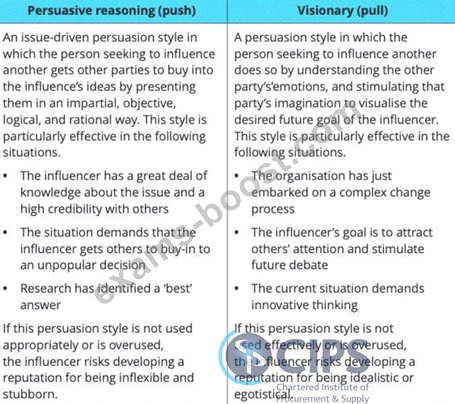
Using logical and objective reasons is one of the typical characteristics of persuasion reasoning method.
NEW QUESTION # 195
The sourcing manager has decided to adopt an adversarial style of negotiation to take advantage of the buyer's greater bargaining power over the suppliers. In what other circumstances should an adversarial relationship be used?
- A. When the supplier is likely to respond with further concessions to maintain a long-term relationship
- B. In all forms of negotiation as each party is always trying to gain advantage over the other
- C. When the issues concerned are non-negotiable, for example, health and safety commitments
- D. In a monopoly market as the supplier will respond by conceding quantity discounts
Answer: C
Explanation:
This question is a duplicate of Question 17. The answer remains the same: When the issues concerned are non- negotiable, such as health and safety commitments (D). Non-negotiable issues require an assertive approach to ensure adherence to essential standards, as highlighted in CIPS's framework for negotiation styles.
NEW QUESTION # 196
Collaborative approach in negotiation not only can fully satisfies the concerns of both, but also ensure that neither party will seek to be opportunistic in later time during the life of the contract. Is this statement true?
- A. Yes, because both parties have well understood each other's goals when they engage in collaborative negotiation
- B. No, because the parties will always find a compromise solution in integrative approach
- C. No, because any party may leverage its own advantage during the contract
- D. Yes, because all parties must have exactly the same goals in integrative negotiation
Answer: C
Explanation:
Integrative, interest-based negotiation can facilitate constructive, positive relationship and establish contracts between parties on a foundation of goodwill. It is important to note it can only facilitate these positive outcomes, it does not guarantee that the other party will not seek to be opportunistic at a later time during the life of the contract. Previous knowledge of the behaviours of the other party regarding honouring contractual and other commitments will be useful here in predicting long-term outcomes, not ensuring that they will not leverage their advantages.
NEW QUESTION # 197
Which of the following are most likely to turn buying organisation into an unattractive customer in supplier's perspective? Select TWO that apply.
- A. Adopting clear and concise CSR policies
- B. Using SRM technology
- C. Unclear tender award criteria
- D. Demands for kickback
- E. Reduced paperwork in procurement processes
Answer: C,D
Explanation:
Becoming a preferred customerto supplier's perspective can increase the purchaser's leverage in negotiation.
Beside the size of buying organisation or its spend, the following may be sufficient to differentiate the buyer from other buying organisations:
Simple procurement processes: Using SRM technology may help to simplify the process Simple contracting processes Clear and concise documentation: Reduced paperwork helps both supplier and buyer save their time and resources.
Absence of onerous supplier terms and conditions
On-time payment
Transparent processes: Unclear tender award criteria can be seen as opaque. Suppliers who attended the tendering processes cannot know the reasons why their bids are rejected and hesitate to attend other tendering.
Ethical behaviour: Suppliers may prefer a buyer who adopts CSR policy because they can predict potential customer's behaviour. Demands for kickback are unethical behaviours.
NEW QUESTION # 198
Toby is an international sourcing category buyer within a third sector (not-for-profit) organisation. He has chosen to use a more adversarial style of negotiation as he believes his organisation has greater bargaining power over the supplier.
In what other situation would an adversarial relationship be used by Toby?
- A. In all forms of negotiation as each party is always trying to gain advantage over the other
- B. When there is a mutual objective from the category buyer and supplier for efficiencies
- C. In a monopoly market, as the supplier will allow the category buyer quantity discounts
- D. When there is a short-term transaction focus from the category buyer's organisation
Answer: D
Explanation:
An adversarial (win-lose) negotiation approach is most appropriate where the relationship is short-term and transactional, and where long-term collaboration is not required. In such situations, the buyer may focus on maximising immediate value rather than building trust or joint efficiencies. A monopoly market places power with the supplier, making adversarial tactics ineffective. Where there are mutual objectives for efficiencies, an integrative (win-win) approach is more suitable. CIPS makes clear that adversarial negotiation is not appropriate in all negotiations, only where conditions such as short-term focus, low relationship dependency, and buyer power exist.
Reference: CIPS L4M5 Commercial Negotiation (CORE), 2nd edition - LO 1.1: Adversarial vs integrative negotiation approaches and when to apply them.
NEW QUESTION # 199
A buyer is approaching a negotiation where the company is in a low-power negotiating position in relation to the supplier. How can the buyer improve leverage and power with the supplier?
- A. 1 and 2 (Consolidate expenditure and understand supplier costs)
- B. 1 and 4 (Consolidate expenditure and limit communication)
- C. 2 and 3 (Understand supplier costs and take a distributive approach)
- D. 3 and 4 (Take a distributive approach and limit communication)
Answer: A
Explanation:
Reference: CIPS L4M5 Study Guide, Section 1.3 - Sources of Power in Negotiation
NEW QUESTION # 200
Which of the following are indicative behaviours of a distributive approach to negotiating?
- A. 1 and 4 only (Maintaining openness and Attempting to cast doubt)
- B. 2 and 3 only (Establishing power and Seeking understanding)
- C. 1 and 3 only (Maintaining openness and Seeking understanding)
- D. 2 and 4 only (Establishing power and Attempting to cast doubt)
Answer: D
Explanation:
Reference: CIPS L4M5 Study Guide, Section 1.2 - Approaches to Negotiation
NEW QUESTION # 201
AB Manufacturing seeks to buy a new materials resource planning (MRP) software system. At the 'defining the business need' stage of the procurement cycle, the procurement manager ensured that all the internal stakeholders involved had the power to contribute and sign off on requirements. For the MRP system, the procurement manager consulted the head of production planning of AB Manufacturing. The head of production contributed to demand levels, existing manufacturing planning, and existing staff levels. What type of power does the head of production demonstrate?
- A. Expert
- B. Referent
- C. Reward
- D. Legitimate
Answer: A
Explanation:
Reference: CIPS L4M5 Study Guide, Section 1.3 - Sources of Power in Negotiation
NEW QUESTION # 202
There are many factors which will influence supplier pricing decisions. Which of the following are external factors that may apply? Select THREE that apply:
- A. Where the product is in its 'lifecycle'
- B. Objectives of the organisation
- C. Environmental factors affecting the cost of raw materials
- D. Cost of production
- E. Price elasticity of demand
- F. Customer perceptions of value
Answer: A,C,E
Explanation:
Reference: CIPS L4M5 Study Guide, Section 2.2 - Cost and Price Analysis
NEW QUESTION # 203
In a commercial negotiation, a procurement professional negotiates on his company's behalf. The power of buying organisation is the only factor that influences the behaviours of the other party. Is this assumption true?
- A. No, because personal power of negotiators also attributes tothe outcomes
- B. Yes, because the outcomes of negotiation are attributable to the buying organisation
- C. No, because power of supplier is the only factor that influences the other party
- D. Yes, because buyer's brand, reputation and purchasing spend largely determine the outcomes
Answer: A
Explanation:
The assumption is false, because when aprocurement professional negotiates on behalf of his employer, he brings the power of his organisation (its brand, reputation and purchasing spend) as well his own personal power (that which is embedded within him) to the negotiation.
From a negotiation perspective, both organisational and personal power have the ability to influence the behaviours of other or the cause of event. This power is clearly core to negotiation, and of enormous important in seeking to achieve the objectives.
NEW QUESTION # 204
Should a buyer use closed questions in a negotiation?
- A. Yes, because closed questions help to reconfirm certain facts
- B. Yes, because they urge the supplier to provide more :
- C. No, supplier will consider closed questions as provocation
- D. No, the buyer should maximise the use of open questions
Answer: A
Explanation:
:
Asking questions the right way is both an art and a science. Ask the question the wrong way, and the other negotiator might act like a turtle, becoming defensive and withdrawing into their shell. Ask the question the right way, and the other negotiator might "spill the beans.".
Closed Questions: How and when to use them?
Closed questions are those that require a short and focused answer, and are especially helpful in the beginning stages of the negotiation to encourage interaction. They can be used to clarify a point, or to reconfirm certain facts. For example, you can use a closed question to confirm the amount of units the company can produce in a week, or to clarify that what they are really saying is that they don't feel comfortable outsourcing their accounts to India. Most closed questions only require a simple "yes" or "no" response, so there really isn't much room for misinterpretation - great for finding out where both you and they stand.
NEW QUESTION # 205
A buyer is approaching a negotiation where the company is in a low-power negotiating position in relation to the supplier. How can the buyer improve leverage and power with the supplier?
- A. 1 and 2 (Consolidate expenditure and understand supplier costs)
- B. 1 and 4 (Consolidate expenditure and limit communication)
- C. 2 and 3 (Understand supplier costs and take a distributive approach)
- D. 3 and 4 (Take a distributive approach and limit communication)
Answer: A
NEW QUESTION # 206
Sally is negotiating with an oversea supplier on the price and payment period. Her company and the supplying organisation are equal in bargaining power. The supplier says that they are investing in new facilities and machinery so the payment period should not be longer than 30 days. Sally knows that her company often pays the suppliers after 45 days from the delivery, but at the moment the company has positive cash flow and it is able to pay immediately. Which of the following should be Sally's concession plan?
- A. Demand for a discount without any other concessions
- B. Agree with supplier's payment period without any further demand
- C. Shorten payment period but ask for a discount
- D. Contend on the normal payment period
Answer: C
Explanation:
In the scenario, the length of payment period is particularly important to the supplier as they are investing new facilities. Otherwise, the buyer's company has a positive cash flow position and budget is available for a shorter payment terms. So this tradeable (payment period) is important to supplier but it is not a significant problem with the buyer. This tradeable will fall within 'Easy concession to trade' quadrant in the following matrix:
Table Description automatically generated
If the tradeable fall within this quadrant, Sally should shorten the payment period in supplier's favour and try to win as many concessions as possible in return. Asking for a discount may be a reasonable trade-off.
LO 2, AC 2.3
NEW QUESTION # 207
Which of the following are most likely to help buyer become preferred customer in supplier's perspective?
Select TWO that apply.
- A. Compliance with agreed repair lead time
- B. Ensuring an increased number of repeat orders
- C. Shorter payment period
- D. Reduction in delivery errors
- E. Onerous supplier terms and conditions
Answer: B,C
Explanation:
Becoming a preferred customer to supplier's perspective can increase the purchaser's leverage in negotiation.
Beside the size of buying organisation or its spend, the following may be sufficient to differentiate the buyer from other buying organisations:
- Simple procurement processes
- Simple contracting processes
- Clear and concise documentation
- Absence of onerous supplier terms and conditions (onerous supplier terms and conditions mean that obligations imposed on suppliers are greater than their gains)
- On-time payment: The reduction in hassle for both supplier and the buyer, if bills are paid on time, is significant. From the customer's perspective it could also be the opener to agreeing preferential payment terms. A supplier may weigh up that payment on time at 60 days is worth taking, over the current 30-day terms that slip to 90 days and beyond.
- Transparent processes
- Ethical behavior
LO 1, AC 1.3
NEW QUESTION # 208
Which of the following two are recognized strategies to achieve a win-lose outcome?
Making the other party lower its resistance point
Making the other party think this settlement is the best it can achieve Employ empathy to gain mutual understanding Using compromise and creativity tactics
- A. 1 and 3 only
- B. 1 and 2 only
- C. 2 and 4 only
- D. 3 and 4 only
Answer: B
Explanation:
In a win-lose outcome, tactics often involve lowering the other party's resistance point (1) and convincing them that the offer is the best possible (2). These strategies are designed to maximize advantage for one party at the expense of the other, fitting with CIPS's win-lose negotiation techniques.
NEW QUESTION # 209
An organization should develop different relationships which are appropriate to each supplier situation.
Which ONE of the following analysis methods could help to identify these?
- A. A spectrum of non-critical items
- B. Resources and cost spectrum
- C. The relationship spectrum
- D. The color spectrum
Answer: C
Explanation:
The relationship spectrum categorizes supplier relationships based on factors like strategic importance, allowing organizations to tailor their approach to each supplier relationship. CIPS emphasizes the relationship spectrum as a valuable tool for assessing and managing supplier interactions based on strategic relevance.
NEW QUESTION # 210
Telephone is most likely to be used for which of the following negotiations?
- A. High value contract
- B. Routinetransactions
- C. Contract for purchasing a specialised product
- D. Complex one-off purchase
Answer: B
Explanation:
Explanation
Many commercial negotiations could be considered routine or just not worth the investment for buyers, and using the phone can make more sense and can be more immediate.
LO 2, AC 2.4
NEW QUESTION # 211
......
CIPS L4M5 certification exam is a valuable qualification for procurement and supply chain professionals seeking to advance their careers and enhance their negotiation skills. Commercial Negotiation certification provides professionals with a comprehensive understanding of commercial negotiation and equips them with the skills and knowledge needed to excel in their roles. The CIPS L4M5 certification is recognized globally and is highly valued by employers, making it an excellent investment for professionals looking to boost their careers.
Updated CIPS Study Guide L4M5 Dumps Questions: https://testking.exams-boost.com/L4M5-valid-materials.html